
January 7, 2026
Kansas and South Carolina: Arts in Medicine Partnerships
Incorporating the arts into patient treatments can improve clinical health outcomes. A growing body of evidence shows that the arts provide direct health benefits across a range of health concerns, improving patient outcomes for many medical conditions, ameliorating loneliness and isolation, and strengthening mental health. These benefits can occur throughout all stages of life, from pediatric care to healthy aging, and can be especially powerful for specific populations, such as veterans. Utilizing the arts also can reduce health care costs, thereby strengthening economic outcomes. In sum, the arts offer policymakers and medical practitioners a suite of options for addressing different health care needs.
Likewise, the approaches state arts agencies take with arts and health programming are multifaceted, varying in focus depending on a state’s specific context and needs. One innovative approach SAAs have taken is to partner with university medical facilities to provide arts based therapies. The Kansas Arts Commission and the South Carolina Arts Commission illustrate the strengths of this approach.
Kansas
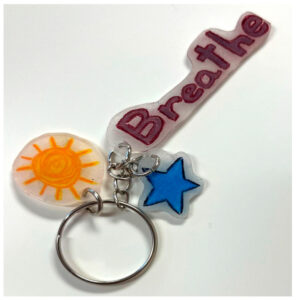
Example of a novel art media created by emergency dispatchers to promote self-care
The Arts in Medicine (AIM) initiative, a partnership between the Kansas Arts Commission (KAC) and the Art Therapy program at Emporia State University (ESU), links organizations that provide medical services to Kansans with Emporia State University art therapy faculty and graduate students. The intent is to create new programs that support patients, clients or health care staff. KAC manages the application and selection process and works with the ESU’s art therapists to target programming. Now in its sixth year, art therapy programs created through the partnership have ranged across settings—including children’s hospitals, cancer-care centers, behavioral health centers, nursing homes and more—and have served medical professionals, patients, staff, families and caretakers. A recent pilot study of the AIM partnership has informed both programming design and research evaluation design.
Exploratory research and observations of the partnership found that the need for art therapy was not just limited to patients, but also included medical professionals and staff, especially regarding the benefits arts practices have for promoting self-care habits. In turn, KAC clarified in its call for applications that opportunities for medical professionals were highly sought. Moreover, the preliminary results of the pilot study were promising, with 96% of survey participants reporting that if art therapy was offered to faculty again, they would participate. While statistically significant conclusions were difficult to draw because of the small sample size, the researchers identified more effective data collection strategies and will be able to complete a statistical analysis of the survey responses and results in the future.
This year, KAC connected the AIM team at Emporia State University with faculty leaders in the Drama Therapy program at Kansas State University, the Music Therapy program at the University of Kansas and the University of Kansas Medical Center to design a pilot program for statewide, multi-university, multidiscipline creative therapies expansion. As part of this effort, the AIM team is presenting a series of outreach and wellness events across the state to introduce more of the medical community to creative therapies.
South Carolina

Photo courtesy of South Carolina Arts Commission
The school based Creative Arts Therapy Initiative (CATI), a partnership between the South Carolina Arts Commission (SCAC) and the Medical University of South Carolina (MUSC), serves students with a focus on supporting mental health through the arts. The initiative, which includes modalities like art therapy, music therapy and dance/movement therapy, was first developed in 2021 after experts declared a national emergency in children’s mental health. SCAC’s School Arts Support Grants help schools incorporate CATI. By the end of FY2024, SCAC funding had helped expand the program from 29 schools in six counties to 52 schools statewide, impacting 689 students. SCAC has also expanded its partnership with MUSC to fund three additional full-time art therapists—each of whom are working in one of SCAC’s Art Hubs—which as has allowed the CATI program to reach communities that have not always had access to dedicated art therapists. These new clinicians are working both within the school districts in their regions and in community spaces.
CATI has received positive evaluations, with the 2023 CATI impact report detailing that:
- 82% of teachers agree that the use of art therapy in schools was beneficial for students’ overall well-being,
- 97% of guardians reported the art therapy groups gave their child an alternative form of safe expression, and
- 92% of teachers would like to see art therapy continue.
For more information on arts and health programming, contact NASAA.