


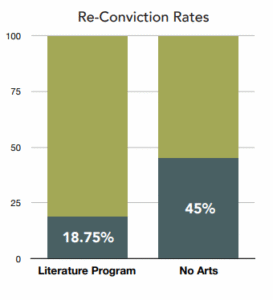
The benefits of correctional arts programs are well established across a breadth of outcomes, impacting recidivism rates, state cost savings, individual health and self-esteem, education, and vocational skills. State arts agencies have long been at the forefront of correctional arts programming, whether by administering these programs directly or by supporting these programs through funding grantees.
In the 1970s, the Oklahoma Arts Council (OAC) launched the Arts-in-Prisons initiative, hiring 20 teaching artists to lead residencies in correctional institutions. However, when legislative priorities in Oklahoma changed in the 1990s, these programs ended. More recently, OAC released Investing in Hope: Restoring Arts in Incarceration, making recommendations for state leaders to reinstate the Arts-in-Prisons program and cultivate partnerships to sustain the program. The report serves as a model for other state and jurisdictional arts agencies seeking to advocate for programming and build partnerships in their own states.
The Investing in Hope report provides an overview of the arts as a powerful tool for criminal justice reform and rehabilitative goals, citing evidence of the benefits and cost reductions from correctional arts programs nationwide, as well as specific examples of state arts agencies demonstrating leadership in the field. OAC’s report also provides state leaders with actionable steps to leverage the arts in criminal justice reform. These include:
- Revive Oklahoma’s leadership role by restoring funding and building infrastructure for artist residencies and arts programming in correctional facilities.
- Foster collaborations led by the Oklahoma Arts Council with the Oklahoma Department of Corrections, Oklahoma Department of Mental Health and Substance Abuse Services, Oklahoma Department of Juvenile Affairs, and community nonprofits.
- Implement evaluation and data tracking by developing a statewide evaluation framework to track program impacts on recidivism, behavior, academic performance and community perceptions. Empower the Oklahoma Arts Council to partner with universities to measure outcomes and build a case for long-term investment.
- Invest in arts education and arts in alternative education as proven prevention strategies.
To learn more about state arts agency reports and programming, contact NASAA.