

March 3, 2026
Virginia: Small and Rural Arts Network
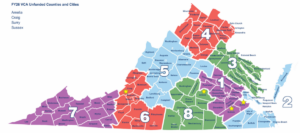
Stars indicate Virginia counties and cities not funded by the Virginia Commission for the Arts. The Small and Rural Arts Network pilot program begins with Region 8 and is designed to reach previously unfunded areas. Image courtesy of VCA
Virginia’s Small and Rural Arts Network (SARA) is a new statewide network connecting small and rural art organizations and artists for the purpose of peer exchange, information sharing and promoting best practices.
For the Virginia Commission for the Arts (VCA), what started as a routine planning question soon blossomed into a multipartnership pilot program reaching previously unserved constituents. After issuing a survey to identify constituent needs—and in alignment with its strategic plan priority to expand access to the arts for all Virginians—VCA received feedback from over 100 artists and arts organizations previously unaffiliated with VCA. The findings indicated that these artists and organizations needed increased capacity and network building, and addressing this need would be a critical way for VCA to reach areas of the state that were without current grantees.
With this in mind, SARA is designed for communities with limited traditional arts infrastructure—beginning with Virginia’s Region 8—to expand arts opportunities by introducing adaptable strategies tailored to small-community contexts. Approaches are attuned to the types of structures commonly available in rural areas and small towns, such as pop-up programming, partnerships with libraries and YMCAs, volunteer-driven governance models and mobile arts delivery.
VCA has several partners to help implement the program over phases. Led by Randolph College, the pilot features three in-person workshops on best practices paired with a Regional Practice Hub hosted by Small Town Big Arts. Each workshop will include a framing session (“What Works in Small-Town Arts Delivery”); two rotating minimodules (e.g., organizing without a building, volunteer governance); a hands-on project-planning lab; and a local mixer for community partners and participants. In turn, the Regional Practice Hub will serve as a digital home for workshop materials, practice cards, resource briefs and action plan templates. It will also host an open virtual forum for statewide practitioners to share questions, early wins and project progress, as well as other curated content.
The national partner, the nonprofit Department of Public Transformation (DoPT), will contribute to project design, facilitation and technical assistance, including two virtual workshops for participants statewide, as well as virtual planning and coaching to support curriculum design, facilitation strategy and Practice Hub resource development. In addition, DoPT will engage Virginia Tech’s Arts Leadership and Urban Planning programs, training students and faculty to prepare them to collaborate on the expansion of the SARA network. The Virginia Tech students and faculty will help build a database of artists and collect data to shape the next iteration of SARA as the program prepares its next phase in a new region and expand statewide. More resources will become fully available by April at smalltownbigarts.com.
For more information on rural programming, and for more information on SAA partnerships, contact NASAA.