
March 3, 2026
From the Field
New Policy Brief Makes the Case for Creative Aging
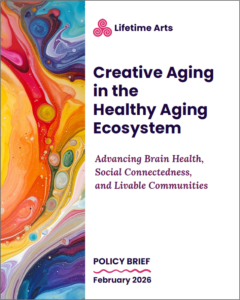
Lifetime Arts has released a new policy brief, Creative Aging in the Healthy Aging Ecosystem, demonstrating the importance of incorporating creative aging into the general healthy-aging policy landscape. As outlined in the brief, with the population of older adults in the United States significantly increasing, policy and care-delivery responses at federal, state and local levels are currently taking shape. It is therefore an opportune time for policymakers and leaders in health care to adopt creative aging as part of these plans.
The author of the report identifies three issues in the healthy aging ecosystem whereby creative aging can offer especially powerful solutions: brain health, social connectedness and livable communities. In addition to elevating these issue areas for policymakers, other recommendations in the report include embedding creative aging principles—especially those emphasizing brain health, social connectedness and livable communities—in federal and state policy and multisector plans and accelerating private-sector investments in creative aging efforts.
How Are Nonprofits and Foundations Responding to Current Challenges?
 Many nonprofits and foundations are currently facing two interlinked challenges. Cuts to federal government funding have created a constrained budgetary environment for the nonprofit sector while, simultaneously, demand for nonprofit services has significantly increased. A new report from the Center for Effective Philanthropy (CEP), A Sector in Crisis: How U.S. Nonprofits and Foundations Are Responding to Threats, provides insights into how nonprofits have responded to these challenges in the current policy and economic context. CEP fielded two surveys and received responses from leaders of 408 nonprofit organizations and 227 foundations. It also conducted in-depth interviews with 27 nonprofit leaders and 31 foundation leaders.
The surveys revealed three key findings:
- First, nonprofit leaders report that the dual challenges of funding cuts and increased demand for their services represent an existential threat to their organizations and the communities they serve. Nearly three-quarters of the surveyed nonprofit leaders are concerned about their organization’s financial stability, and the vast majority attribute these concerns at least somewhat, if not mostly, to the current context. As a result, an overwhelming majority—86%—are pursuing funding from new sources.
- Second, foundation leaders recognize the high stakes of the current context for nonprofits and have made changes to their grant making and processes in response. Some of these changes include providing more emergency or rapid-response grants and providing additional forms of assistance beyond grants, such as partnerships with other nonprofits or funders, resources for staff well-being, and assistance with legal support.
- Third, foundation and nonprofit leaders believe that foundations have an even larger role to play in supporting nonprofits during this time, and many suggest that foundations could and should be doing more. In the upcoming year, nonprofit leaders reported that they hope foundations will assist them in building skills, cultivating relationships, gaining knowledge and acquiring resources that will enable them to best respond to challenges posed by the current context.
Nonprofit and foundation leaders are in alignment with these needs: approximately 40% of foundations and 50% of nonprofits named capacity building as the most helpful action they can take to bolster nonprofits in 2026.
Lessons from the COVID-19 Pandemic for the Arts and Culture Sector
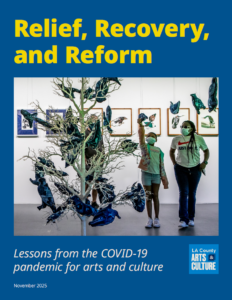 A report from the Los Angeles County Department of Arts and Culture offers a retrospective case study on local responses to emergency funding and spending for the arts and culture sector. Situating LA County within the larger context of recovery efforts in the United States during the COVID-19 pandemic, Relief, Recovery, and Reform documents how the Los Angeles County government used its share of federal dollars, combined with local resources, to invest in relief and recovery for arts and culture. These funds were distributed primarily in the form of grants to nonprofit organizations administered by the LA County Department of Arts and Culture. The report details the policy changes made to accelerate delivery of those funds to the artists and arts organizations that urgently needed them. The report concludes with policy recommendations and best practices to prepare for future emergencies, including simplifying grant making, creating more robust reserve funds and establishing emergency funding mechanisms that can be rolled out immediately.